manim中提供了两种方式来表示文字信息,一种是 Text系列,一种是 Tex系列。Text系列在显示文字信息方面,提供了更多的的属性来调整显示效果。如果有大段的文字要排版,或者对文字的显示效果要求高的话,建议使用 Text。
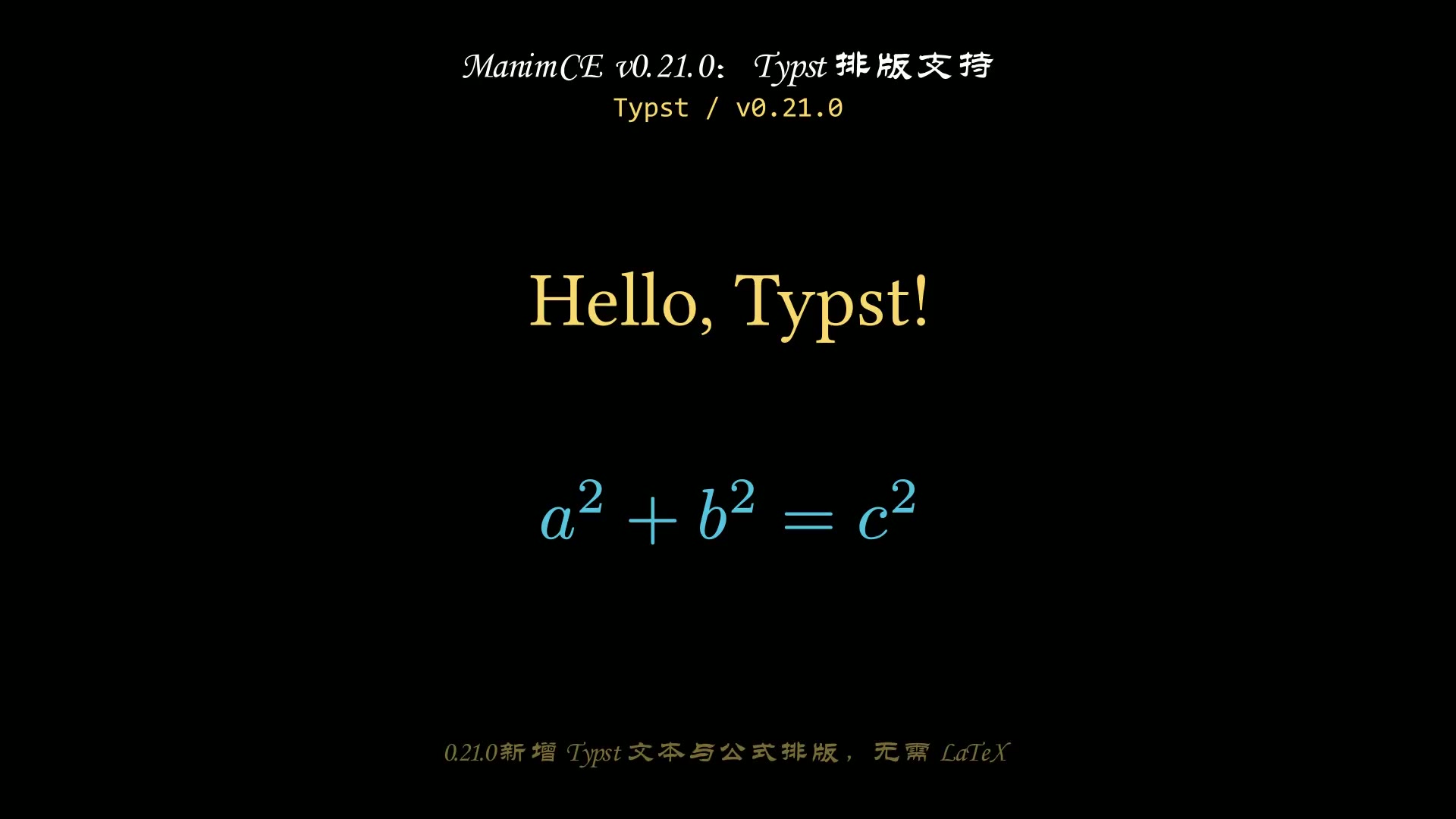
而 Tex系列最大的优势是支持 Latex,也就是说它能更好的显示数学公式。Tex目前还不支持显示中文,如果一段文本中既有中文又有数学公式的话,需要结合 Text和 Tex一起来显示。
下面介绍 Text和 Tex中几种常用的显示文字和公式的方法。
1. Text Text系列常用的对象主要有三种:
Text:一般用于单行的文本
Paragraph:一般用于多行的文本
MarkupText:一般用于富文本显示
1.1 一般文本 一般文本 Text支持显示任何语言:
1
2
3
4
5
6
7
8
9
10
11
12
13
14
15
16
17
from manim import *import numpy as npfrom numpy import array, pi, cos, sinrun_time = 1 data = [[1 , 2 ], [3 , 4 ]] def dot (pos, **kwargs ): return Dot(pos, **kwargs) class Z0023 (Scene ): def construct (self ): sc = self self .play(*[FadeIn(_o) for _o in [Text('hello world' )]], run_time=1.0 ) self .play(*[FadeIn(_o) for _o in [Text('你好,世界' )]], run_time=1.0 ) self .play(*[FadeIn(_o) for _o in [Text('こんにちは世界' )]], run_time=1.0 ) self .play(*[FadeIn(_o) for _o in [Text('Привет, мир' )]], run_time=1.0 ) self .play(*[FadeIn(_o) for _o in [Text('مرحبا بالعالم' , font='sans-serif' )]], run_time=1.0 ) self .wait(0.5 ) self .wait(0.40 )
下载 Python 脚本
运行效果:
1.2 段落文本 段落文本 Paragraph可以多行文本进行简单的排版:
1
2
3
4
5
6
7
8
9
10
11
12
13
14
15
from manim import *import numpy as npfrom numpy import array, pi, cos, sinrun_time = 1 data = [[1 , 2 ], [3 , 4 ]] def dot (pos, **kwargs ): return Dot(pos, **kwargs) class Z0024 (Scene ): def construct (self ): sc = self paragraph = Paragraph(' 春晓\n' , '春眠不觉晓' , '处处闻啼鸟' , '夜来风雨声' , '花落知多少' ) self .play(FadeIn(paragraph), run_time=1.0 ) self .wait(1 ) self .wait(0.5 ) self .wait(3.10 )
下载 Python 脚本
运行效果:
1.3 带标记文本 带标记的文本MarkupText类似HTML,可以像 word 那样提供一些标记文本的功能。
1
2
3
4
5
6
7
8
9
10
11
12
13
14
15
16
from manim import *import numpy as npfrom numpy import array, pi, cos, sinrun_time = 1 data = [[1 , 2 ], [3 , 4 ]] def dot (pos, **kwargs ): return Dot(pos, **kwargs) class Z0025 (Scene ): def construct (self ): sc = self self .play(*[FadeIn(_o) for _o in [MarkupText('<b>bold</b> <i>斜体文字</i>' )]], run_time=1.0 ) self .play(*[FadeIn(_o) for _o in [MarkupText('<u>下划线</u> <s>中划线</s>' )]], run_time=1.0 ) self .play(*[FadeIn(_o) for _o in [MarkupText('<span underline="double">双下划线</span> <span underline="error">错误标记</span>' )]], run_time=1.0 ) self .play(*[FadeIn(_o) for _o in [MarkupText('下标和上标:H<sub>2</sub>O H<sub>3</sub>O<sup>+</sup>' )]], run_time=1.0 ) self .wait(0.5 ) self .wait(1.10 )
下载 Python 脚本
运行效果:
2. Tex Tex系列的对象主要是用来显示数学公式,基于Tex之上,manim还封装了列表 和标题 两种常用的对象。Tex默认只支持显示英文,所以多用于显示公式,显示文本还是 Text系列的对象比较常用。
2.1 数学公式 Tex可以显示任何 Latex格式的数学公式:
1
2
3
4
5
6
7
8
9
10
11
12
13
14
15
from manim import *import numpy as npfrom numpy import array, pi, cos, sinrun_time = 1 data = [[1 , 2 ], [3 , 4 ]] def dot (pos, **kwargs ): return Dot(pos, **kwargs) class Z0026 (Scene ): def construct (self ): sc = self self .play(*[FadeIn(_o) for _o in [MathTex('a^2 + b^2 = c^2' )]], run_time=1.0 ) self .play(*[FadeIn(_o) for _o in [MathTex('E = mc^2' )]], run_time=1.0 ) self .play(*[FadeIn(_o) for _o in [MathTex('e^{i\\pi} + 1 = 0' )]], run_time=1.0 ) self .wait(0.5 ) self .wait(2.10 )
下载 Python 脚本
运行效果:
2.2 列表文本 BulletedList会将传入的多个字符串以列表的方式排列起来:
1
2
3
4
5
6
7
8
9
10
11
12
13
from manim import *import numpy as npfrom numpy import array, pi, cos, sinrun_time = 1 data = [[1 , 2 ], [3 , 4 ]] def dot (pos, **kwargs ): return Dot(pos, **kwargs) class Z0027 (Scene ): def construct (self ): sc = self self .play(*[FadeIn(_o) for _o in [BulletedList('a 2 + b 2 = c 2 , 'E = m c 2 , 'e^{i\\pi} + 1 = 0' )]], run_time=1.0 ) self .wait(0.5 ) self .wait(4.10 )
下载 Python 脚本
运行效果:
2.3 标题 Title自动显示在顶部,它和 BulletedList一样,都是为了减轻排版的负担。
1
2
3
4
5
6
7
8
9
10
11
12
13
14
from manim import *import numpy as npfrom numpy import array, pi, cos, sinrun_time = 1 data = [[1 , 2 ], [3 , 4 ]] def dot (pos, **kwargs ): return Dot(pos, **kwargs) class Z0028 (Scene ): def construct (self ): sc = self import manim self .play(*[FadeIn(_o) for _o in [Title(f'Manim version {manim.__version__} ' )]], run_time=1.0 ) self .wait(0.5 ) self .wait(4.10 )
下载 Python 脚本
运行效果:
3. 总结回顾 Text和 Tex都是用来显示文本的,Text来显示。Tex。
Tex系列的对象只能显示英文,对于我们非英语国家来说,BulletedList 和 Title的。
为了显示中文,可以基于 Text封装自己的 列表 和标题 对象。
0
打赏作者 订阅 分享
主观感受,仅供参考。本文采用 本文采用 CC BY-NC-SA 4.0 许可 协议,
完整转载请注明来自
数学动画引擎 。